

Bill McCoy— America’s Most Notorious Rum Runner
Prohibition in the United States was a nationwide constitutional ban on the production, importation, transportation, and sale of alcoholic beverages from 1920 to 1933.
However, it was not long into the start of prohibition that many began to smuggle alcohol.
With the start of prohibition, Captain Bill McCoy began bringing rum from Bimini and the rest of the Bahamas into south Florida and throughout the Keys. The Coast Guard soon caught up with him and began patrolling the waters of Southern Florida non-stop.

Bill McCoy, being an out of the box thinker, began to bring the illegal goods to just outside U.S. territorial waters and let smaller boats and other captains take the risk of bringing it to shore.
The rum-running business was very good, and McCoy soon bought a Gloucester knockabout schooner named Tomoka. He installed a larger auxiliary, mounted a concealed machine gun on her deck, and refitted the fish pens below to accommodate as much contraband as she could hold. She became one of the most famous of the rum-runners of all time, along with his two other ships hauling mostly Irish and Canadian whiskey as well as other fine liquors and wines to ports from Maine to Florida.
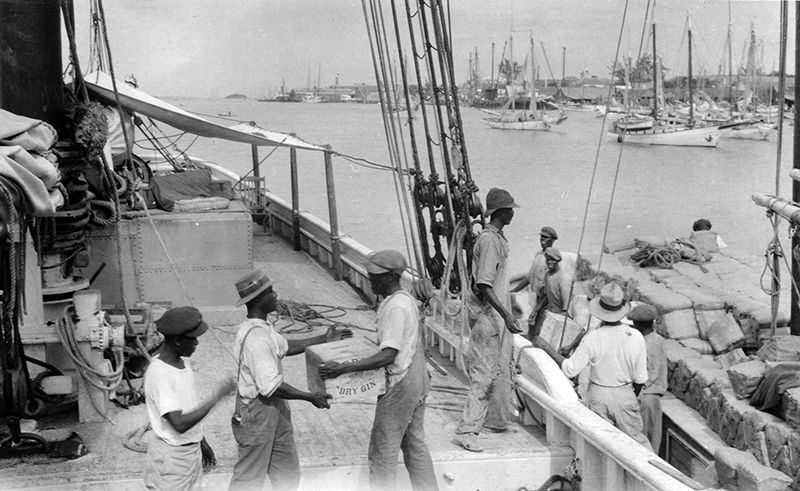
In the days of rum running, it was common for captains to add water to the bottles to stretch their profits or to re-label it as better goods. Any cheap sparkling wine became French champagne or Italian Spumante; unbranded liquor became top-of-the-line name brands. McCoy became famous for never water in his booze and selling only top brands. Although there are several other origin stories, McCoys often gets credit for being the origin of the term “The Real McCoy”.
McCoy is credited with the idea of bringing large boats just to the edge of the three-mile limit of U.S. jurisdiction and selling his wares there to “contact boats”, local fishermen, and small boat captains. The small, quick boats could more easily outrun Coast Guard ships and could dock in any small river or eddy and transfer their cargo to a waiting truck.
Soon others were following suit, and the three-mile limit became known as “Rum Line” with the ships waiting called “Rum row”. The Rum Line was extended to a 12-mile limit by an act of the United States Congress on April 21, 1924, which made it harder for the smaller and less seaworthy craft to make the trip.

On November 15, 1923, McCoy and Tomoka encountered the U.S. Coast Guard Cutter Seneca just outside U.S. territorial waters. A boarding party attempted to board, but McCoy chased them off with the machine gun. Tomoka tried to run, but Seneca placed a shell just off her hull, and William McCoy surrendered his ship and cargo.
Instead of a drawn-out trial, Bill McCoy pleaded guilty and spent nine months in a New Jersey jail. He returned to Florida and invested his money in real estate. He and his brother continued the boat building business and frequently traveled up and down the coast. McCoy to this day is remembered as one of the premier Rum Runners.
History of the Rum Runner Cocktail

The Original Rum Runner Recipe was a creation made at the Holiday Isle Beach Resort and Marina in Islamorada. In 1972, John Ebert first walked through the door of the Tiki Bar, applying for a job. When he was asked to make up a new drink as a trial, he looked around the bar stock and decided to put some of the lesser-used liqueurs together to use to impress the manager. He mixed and mixed and came up with what we now call a “Rum Runner.” And the rest they say is history.
Make Your Own Rum Runner
Ingredients:
- 1 oz Light Rum
- 1 oz Dark Rum
- 1 oz Banana Liqueur
- 1 oz Blackberry Liqueur
- 1 oz Orange Juice
- 1 oz Pineapple Juice
- Splash of Grenadine
- Fruit to garnish
Directions:
- Combine all ingredients in a blender with two cups ice
- Blend until smooth then serve in a hurricane glass with fruit garnish and a straw


