


There is, perhaps, no more strikingly colored North American songbird than the male Painted Bunting. This bird catches the attention of anyone whenever one passes within view.
The species (Passerina ciris ) is somewhat common in the Southeast, around brushy areas and woodland edges. It is often secretive, staying low in dense cover. However, males sing their bright warbling songs from higher in the trees, partly hidden among foliage or sometimes out in the sun on an exposed perch.
Those nesting on southern Atlantic Coast probably winter in Florida and northwestern Caribbean; those nesting farther west probably winter in Mexico and Central America.
 Their breeding grounds include a thin strip along the North Carolina Coast so right now you stand a good chance of encountering them in our region.
The painted bunting’s small eastern population has received attention in recent years, however, many details of its conservation status remain murky.
What is known paints a topsy-turvy picture of changing status, with a positive twist: Following years of decline, a consensus has emerged that eastern Painted Buntings seem to be doing better than once believed, at least for now.
The Painted Bunting is split into two geographically isolated populations. One breeds across a wide swath of the south-central United States and in Northern Mexico, with a range encompassing all or almost all of Texas, Oklahoma, Louisiana, and Arkansas, and parts of Mississippi, Kansas, and Missouri.
The much smaller eastern population occurs along a narrow strip of the Atlantic Coast, from northeastern Florida north to eastern North Carolina.
Feeding Behavior
Forages mostly on the ground. Also does some foraging up in shrubs and low trees. During migration, may forage in mixed flocks with Indigo Buntings.
Eggs
3-4, sometimes 5. Whitish to bluish white or pale gray, with reddish brown spots often concentrated at larger end. Incubation is by female only, 11-12 days. Young: Nestlings are fed by the female. Young leave the nest about 12-14 days after hatching, and male may take over feeding them if female begins second nesting attempt. 2 broods per year, sometimes 3, perhaps rarely 4.
Young
Nestlings are fed by the female. Young leave the nest about 12-14 days after hatching, and male may take over feeding them if female begins second nesting attempt. 2 broods per year, sometimes 3, perhaps rarely 4.
Diet
Mostly seeds and insects. Reported to feed mainly on seeds, primarily those of grasses and weeds; sometimes eats berries and fruits. Also eats many insects, including beetles, caterpillars, grasshoppers, flies, and others. Probably eats more insects in early summer, and feeds them to its young.
Nesting
To defend territory, male sings from a raised perch, often partly hidden among foliage near treetop. Males will also engage in serious physical fights, probably in disputes over territorial boundaries. One male may have more than one mate. Nest: Placed in dense bushes, vines, or low in trees, usually 3-9′ above the ground, sometimes higher. Nest (built by female) is open cup woven of grass, weeds, leaves, lined with fine grass, rootlets, and animal hair.
Songs and Calls
Loud, clear, and variable song consisting of a series of high-pitched musical notes. Call is a sharp, metallic tsick.
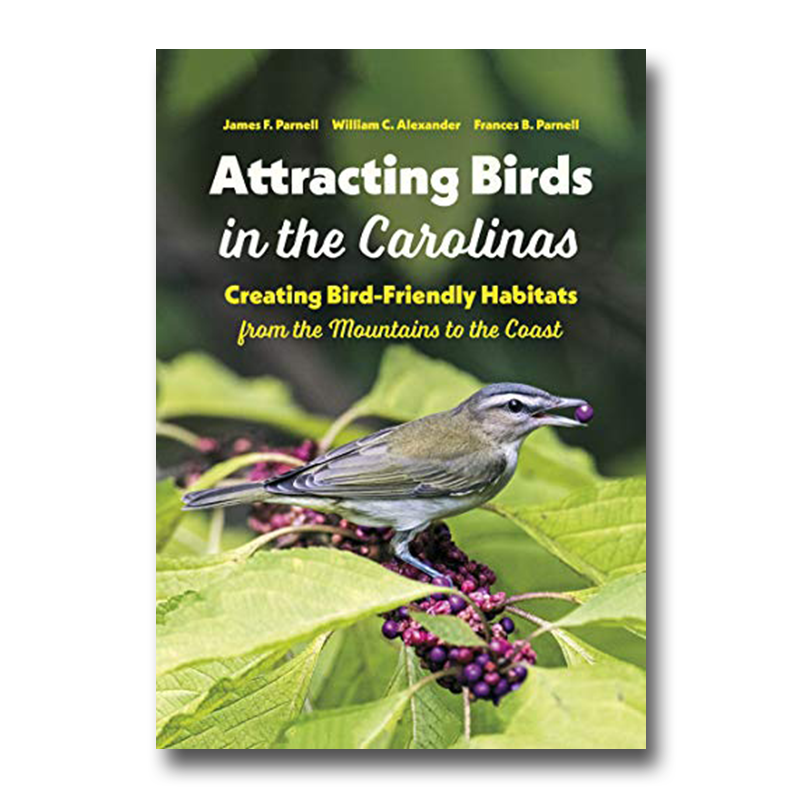
Attracting Birds in the Carolinas:
Covering the Carolinas from up-country to the Piedmont to the Coastal Plain, this book is an in-depth yet accessible primer on the many ways that Carolinians can attract birds–from large wildlife refuges to private sanctuaries, and from farms to suburban homes and even apartments.
The first book to focus specifically on attracting birds in both states, Attracting Birds in the Carolinas includes information on birds’ basic needs and their annual reproduction and migration cycles, and provides helpful tips on how to modify your outdoor space to invite avian visitors.


