

The shipwreck of a large iron-hulled Civil War era steamer has been discovered in the Atlantic Ocean off the coast of North Carolina, near Oak Island.
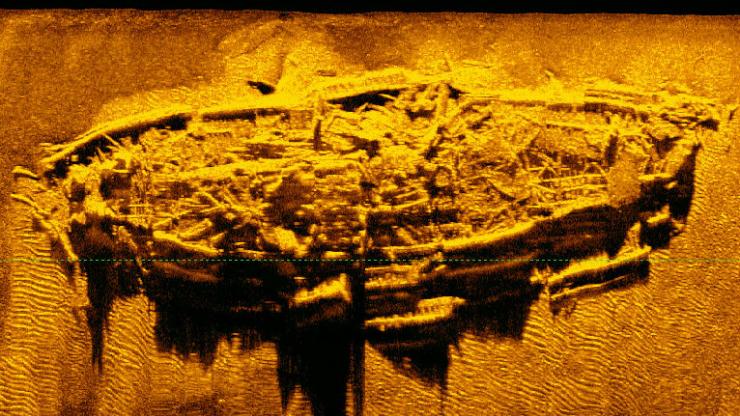
Another pearl in the form of a large iron-hulled Civil War era steamer has been discovered in the Atlantic Ocean off the coast of N.C., near Oak Island. Researchers and archaeologists from the Underwater Archaeology Branch of the North Carolina Office of State Archaeology and the Institute of International Maritime Research made the discovery Saturday, Feb. 27 during sonar operations.
The vessel is believed to possibly be the remains of one of three blockade runners used to penetrate the wall of Union naval vessels blocking the port of Wilmington during the Civil War. The goal of the Union blockade was to keep supplies from reaching the Confederacy through one of its most important ports and to prevent the export of cotton and other marketable items by the Southerners. The wreck is located 27 miles downstream from Wilmington near Fort Caswell at the mouth of the Cape Fear River, and is the first Civil War-era vessel discovered in the area in decades.
“A new runner is a really big deal,” said Billy Ray Morris, Deputy State Archaeologist-Underwater and Director of the Underwater Archaeology Branch. “The state of preservation on this wreck is among the best we’ve ever had.”
Researchers will continue working to positively identify the vessel. Three blockade runners are known to have been lost in the area, the Agnes E. Fry, Spunkie and Georgianna McCaw. These operations are part of a major project funded by the National Park Service through the American Battlefield Protection Program.
Historical, cartographic and archaeological resources have been examined for the past two years to better understand the maritime components of the Fort Fisher campaign. Fortifications protected both entrances to the Cape Fear River from the Atlantic and were critical in keeping open a lifeline to the Confederacy until Fort Fisher fell in January 1865.
Researchers aboard the Research Vessel Atlantic Surveyor recorded the complete hull of the vessel. Students from the East Carolina University Maritime Studies Program will join the team as they continue gathering data on the new site as the weather permits.
The Underwater Archaeology Branch within the Office of State Archaeology is part of the North Carolina Department of Natural and Cultural Resources.
The last Civil War era ship discovered was wreck believed to be the Planter, a Civil War-Era Confederate ship that was commandeered by slaves and turned over to the Union army 152 years ago. Marine archaeologists started looking for the remains of the sunken ship in 2010, when a historical document surfaced that detailed how the Planter sank in 1876.
Buried iron objects indicating a sunken ship have been discovered off the coast of South Carolina that experts believe is the Planter, a Civil War-Era Confederate ship that was commandeered by slaves and turned over to the Union army 152 years ago.
Marine archaeologists started looking for the remains of the sunken ship in 2010, after reviewing historical documents that detailed how the Planter sank in 1876.
According to the National Oceanic and Atmospheric Administration, evidence of the shipwreck was found near Cape Romain buried under 10 to 15 feet of sand.
Archaeologists from NOAA’s Office of National Marine Sanctuaries announced their discovery on the anniversary of when slaves took the Planter to freedom, but there still has to be further investigations to confirm that that remains are from the historic ship.
In 1862, Robert Smalls sailed his family to safety by disguising himself as the captain of the Planter to make it past the Confederate sentries stationed at Charleston Harbor.
After fighting in the Civil War, and piloting a Union ironclad warship in an attack on Fort Sumter, Smalls went on to serve on the South Carolina general assembly, then as a United States congressman for South Carolina and a federal customs inspector.


